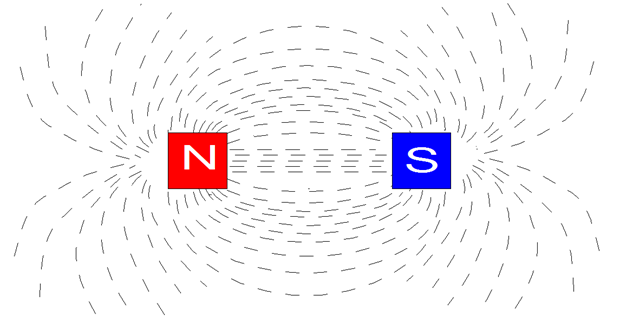
Lines Of Force
Faraday used the concept of lines of force to explain what happens in the space between two magnets. He suggested properties for these lines of force, which he imagined as spreading out from all magnetic poles into the surrounding space. The symbol Φ (Phi) is used to represent magnetic lines of force. Magnetic lines of force may also be termed magnetic flux.
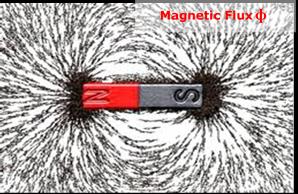
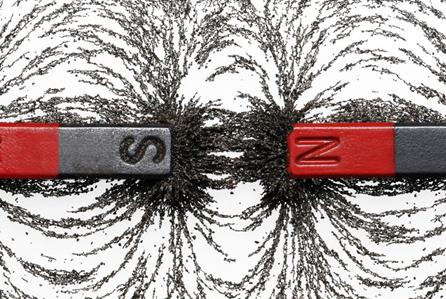
By assuming the lines were in tension, like pieces of stretched elastic, he could account for the attraction of unlike poles, since the lines of force stretch from one pole to another.
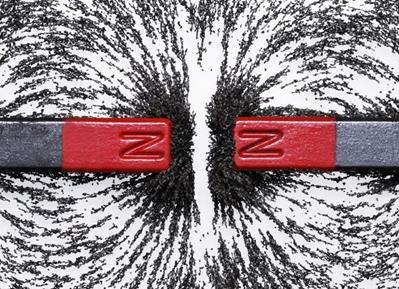
But the tension of the lines of force must increase as they shorten, since the repulsive force between two like poles increases as the poles approach. With like poles, the lines of force also tend to curve outwards, seeming to suggest that they repel each other. Faraday used this hypothesis to account for the repulsion of like poles.
The properties of magnetic lines of force are as follows:
- They form closed loops between north and south poles.
- They do not cross one another.
- They seek paths of least magnetic resistance.
- Their density decreases with increasing distance from the poles, i.e. the number of lines of force in a unit area decreases.
- They are considered to have direction, that is: from the north pole to south pole external to the magnet, and from the south pole to the north pole within the magnet.
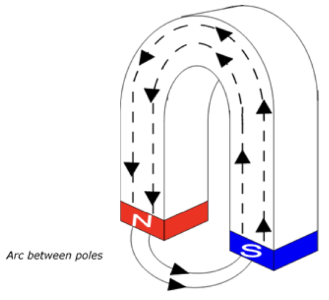
Within a magnet - South to North.
Outside Magnet - North to South